That’s useful if you need to check a result, but less useful if you need to solve the next problem on a test with no chatbot beside you. The difference between using AI as a tutor and letting it do the learning is what happens before you ask—and what you can do after you close the chat.
A good AI study session starts with your attempt, uses the tool to expose a gap, and ends with another attempt of your own. This works best as a repeatable habit, not an emergency measure the night before an exam. If you’re practicing a language, for example, a language-learning routine you can sustain gives you regular chances to speak, write, and recall words yourself; AI can help you make those practice sessions more focused.
Judge the session by what you can do without AI
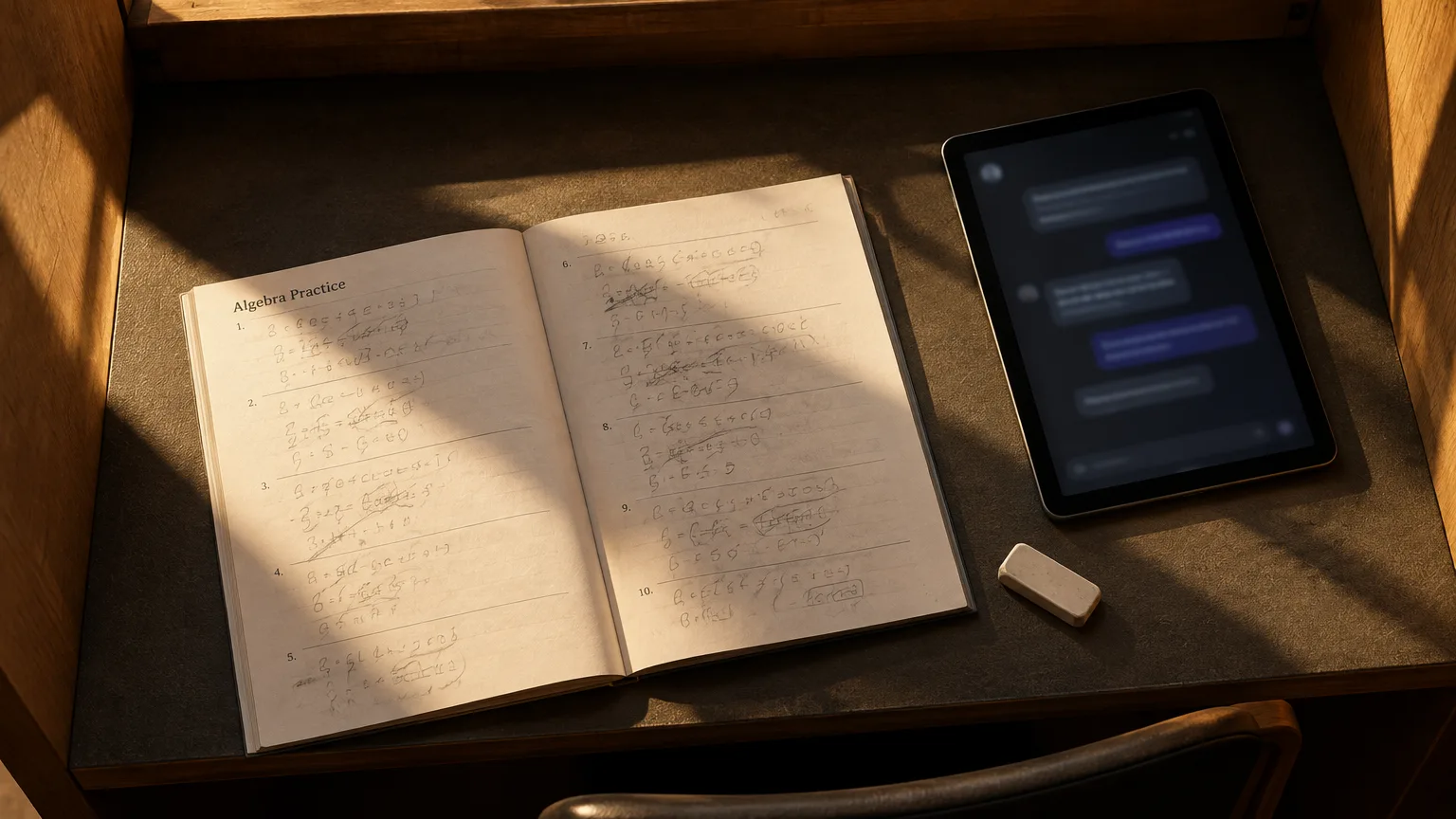
Getting a correct answer with help can feel like learning. It may only show that you followed a convincing explanation. In a study of nearly 1,000 high school math students, access to a general-purpose AI chatbot improved performance on practice problems, but students using it scored worse on a subsequent unassisted exam than students who had no AI access. A version designed to offer teacher-informed hints rather than readily giving away solutions largely avoided that drop; it did not, however, produce a clear advantage on the unassisted exam. The experiment was in one school and one subject, so it isn’t a verdict on every use of AI. It is a sharp warning against mistaking assisted work for independent skill.
Use a simple test: Could you explain the idea, solve a similar problem, or defend your argument with the chat closed? If not, keep studying. The goal isn’t to avoid help. It’s to use help that makes your next independent attempt stronger.
Start with your own work, then ask for the smallest useful hint
Before opening an AI tool, read the assigned material and make a real attempt. Write down what you know, the step you tried, and exactly where you got stuck. “I don’t understand algebra” gives a tutor little to work with. “I can find factor pairs of 12, but I’m not sure which pair fits this quadratic” identifies a teachable gap.
Then set a boundary in your prompt:
I’m studying [topic] at [course level]. Here’s what I tried: [your work]. Don’t solve the problem or give the final answer. Ask me one question or give me one small hint about the step where I’m stuck. Wait for my response.
That last instruction matters. A five-paragraph explanation can spare you the very decision you need to practice making. After a hint, stop reading and try the next step on paper. Ask for another hint only if you need one. You can request a full worked example later, but use a different problem so the assigned answer remains yours.
Suppose you’re factoring (x^2+7x+12). You know you need two numbers whose product is 12 and whose sum is 7, but you tried 2 and 6. A useful tutor response would ask you to check that sum and look for another factor pair. It wouldn’t immediately write down the factors. Once you finish, ask the AI to check your reasoning rather than merely announce whether the answer is correct:
Check each step of my solution. Point out the first error, if there is one, and explain why it’s an error. Let me correct it before you show a solution.
Some tools offer guided study features. For instance, ChatGPT’s study mode can ask questions, provide step-by-step guidance, and quiz you. It can also make mistakes or occasionally give a direct answer. The setting helps, but your habit of attempting the work first matters more.
Ask for explanations you can work with
“Explain this more simply” is fine as a first request, but the strongest follow-up names what isn’t connecting. If a biology explanation uses the word diffusion and you don’t know what it means, ask for a concrete example and then explain the concept back in your own words. If two historical events keep blending together, ask the tutor to compare their causes, dates, and consequences—but check those details against your course materials.
These prompts keep an explanation from turning into something you only read:
- “Explain this concept in three sentences, then ask me to restate it in my own words. Tell me what I missed.”
- “Give me an everyday example and one example where this idea does not apply. Ask me to explain the difference.”
- “I think [your explanation]. Which part is inaccurate or incomplete? Don’t rewrite the whole thing for me.”
- “Show me a worked example on a different problem. Then give me a new problem without the steps.”
An explanation is most useful when it leads to a decision you make yourself. The U.S. Department of Education’s study guide recommends combining worked examples with problems students solve and using questions that demand explanations, not just short answers. AI can generate both kinds of practice. You still need to do the explaining and solving.
Turn the chatbot into a quiz partner
AI is especially handy when you need more practice questions than your textbook provides. But ask for questions before answers, and answer without looking at notes or previous chat messages. That act of pulling an idea from memory—retrieval practice—does more for later recall than simply rereading it. In experiments comparing recall tests with additional studying, students who practiced recall retained more after a delay, even though repeated studying could make them feel more confident.
Try this prompt after studying a section:
Quiz me on [specific topic] one question at a time. Start with a basic question, then ask one that makes me apply the idea in a new situation. Wait for each answer. Tell me what I got right, what I missed, and where I should review. Don’t reveal answers early.
If your teacher has provided learning objectives, use those to set the scope. You can also ask for a mix of question types: define a term, explain a cause, compare two approaches, solve a fresh problem. Review missed answers in your notes or textbook; don’t assume the AI’s grading is authoritative.
Come back to the missed questions later, without the chat transcript in front of you. A question you can answer only moments after reading the explanation hasn’t yet shown you what you’ll remember next week.
Keep your voice and reasoning in writing assignments
A writing tutor can be valuable without supplying your sentences. Draft a thesis or paragraph yourself, then ask where a reader might lose the thread. Request questions that expose missing evidence, a weak connection, or a counterargument you haven’t addressed. Make the revision yourself.
For example:
Here’s my draft paragraph. Don’t rewrite it. Identify one claim that needs evidence and one place where my reasoning jumps ahead. Ask me questions that will help me revise it.
For research papers, treat AI-suggested facts and references as leads to investigate, not sources to cite. Find and read the original material before using it. A polished-looking citation from a chatbot is not proof that a source exists or supports the claim. Likewise, if the assignment is meant to assess your analysis or prose, having AI generate an outline, argument, or revised paragraph may cross a line even if you later change some words.
The useful distinction is between feedback on your thinking and replacement of your thinking. A tutor can help you notice a problem. You decide how to fix it.
Check the class rules and protect what you share
Permission to use AI isn’t universal. A class may allow it for exam preparation but prohibit it on a take-home assignment; another may require you to disclose even permitted use. Cornell’s guidance on course AI policies distinguishes among prohibited use, use with attribution, and work in which AI is deliberately integrated. Your own instructor’s directions govern your work. If they’re unclear, ask whether AI-generated practice questions, hints, feedback on a draft, or help with a specific assignment are allowed.
When disclosure is required, describe what the tool actually did: for example, “I used AI to generate practice questions and to flag gaps in my draft; I wrote the responses and revisions myself.” Keep a record of your prompts if your instructor asks for one. An AI citation alone may not explain how it shaped the work.
Be selective about what you paste into a chat. Don’t upload classmates’ work, private student information, confidential research, or restricted course materials just to get a better prompt. Use a short, non-sensitive description of the task when possible, and check whether your school provides an approved tool. The U.S. Department of Education advises schools to review online tools before classroom use because student information and security can be involved. For students, the practical rule is simpler: don’t assume a convenient chatbot is an approved place for private material.
Finish with an independent attempt
A productive session can be short. Try the work, get one hint, correct your reasoning, answer a few questions from memory, and close the chat. Then do a fresh problem or explain the topic aloud without help. If you can’t, you’ve found the next thing to practice—not a reason to ask AI to finish it.
The best AI tutor doesn’t leave you with the cleanest-looking page. It leaves you able to handle the next blank one.