A 150-pound adult can find three different protein numbers without finding a mistake. The long-standing Recommended Dietary Allowance works out to about 54 grams a day. The 2025–2030 Dietary Guidelines for Americans point to roughly 82–109 grams for someone that weight. An athlete in hard training may aim higher still. Those figures answer different questions: how much meets the needs of nearly all healthy people, what federal food guidance recommends as a broader goal, and what may support demanding exercise.
You don’t need to hit a precise number at every meal. But age, pregnancy, training, and health conditions can change which number is useful. Start with the benchmark that fits your situation, then check whether your usual food gets you there.
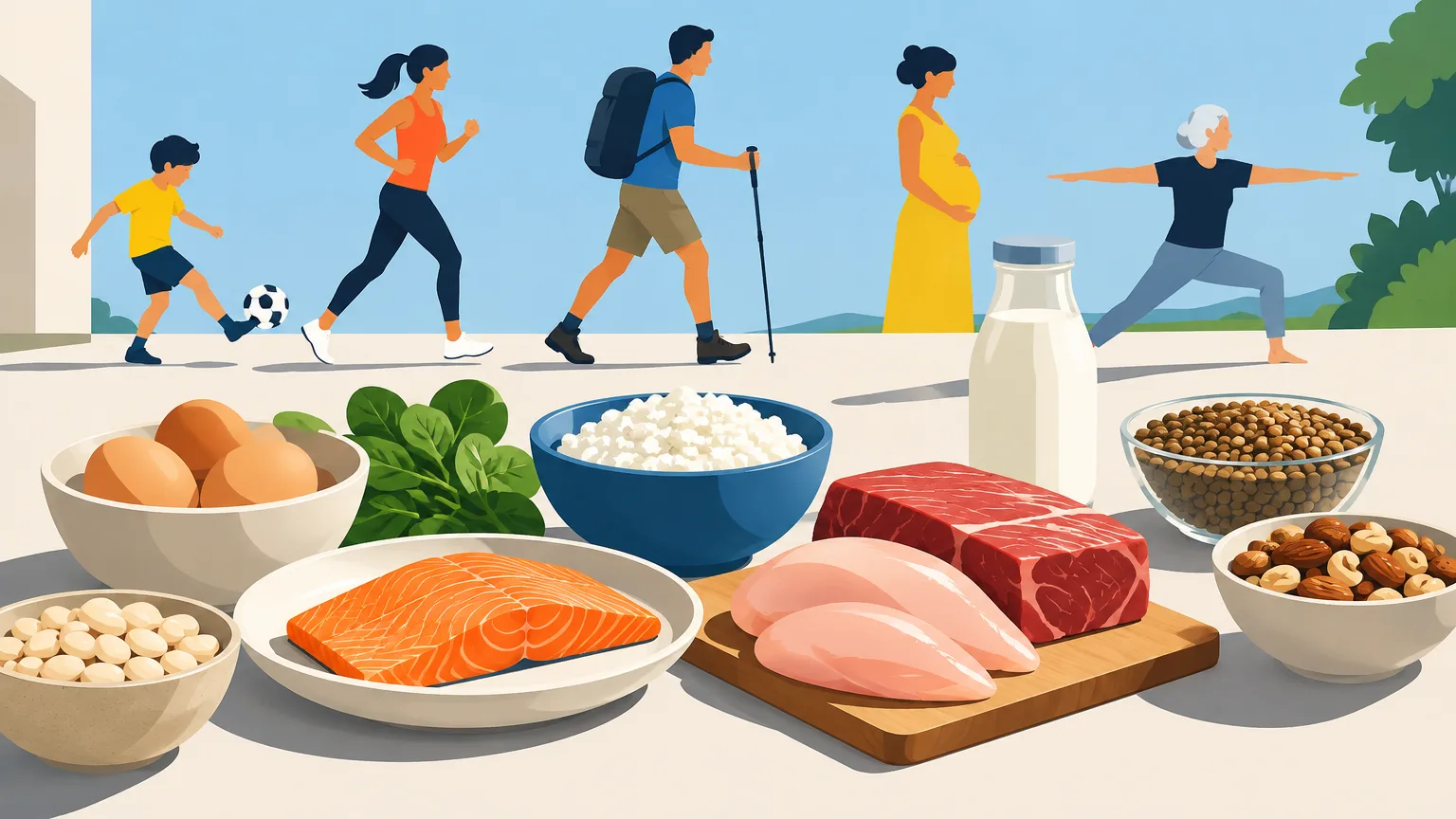
Start with the right kind of number
The Recommended Dietary Allowance, or RDA, is designed to meet the needs of nearly all healthy people in an age and sex group. For adults, it is 0.8 gram of protein per kilogram of body weight per day—about 0.36 gram per pound. It remains a useful reference for basic adequacy, but it isn’t a ceiling or a promise that more protein offers no benefit.
The 2025–2030 Dietary Guidelines for Americans set a protein goal of 1.2–1.6 grams per kilogram of body weight per day, adjusted as needed for calorie needs. That is a dietary goal, not a replacement for every age-specific RDA or a prescription for someone with a medical condition. For a 150-pound person, it works out to about 82–109 grams. A larger person will get a larger number from the same formula.
A third figure often causes confusion: the FDA’s 50-gram Daily Value for protein. It is a standardized reference for comparing packaged foods, not a personalized target. For general food labels, 20% of the 50-gram Daily Value represents about 10 grams of protein after adjustment for protein digestibility and amino acid score; it doesn’t tell you whether 50 grams is enough for you. The serving’s actual protein grams can be higher; read the grams listed on the label.
To use a body-weight target, divide your weight in pounds by 2.2 to get kilograms, then multiply by the appropriate grams-per-kilogram figure. For a quick estimate, 0.8 g/kg is about 0.36 g per pound, while 1.2–1.6 g/kg is about 0.55–0.73 g per pound. These calculations are starting points; body size alone can’t account for training load, appetite, illness, or changes in muscle mass.
Protein needs from childhood through older age
The National Academies’ protein reference values give the following RDAs. The gram amounts for children and adults are based on reference body weights, so they are not tailored to every individual.
| Life stage | Protein RDA per day |
|---|---|
| Ages 1–3 | 13 g |
| Ages 4–8 | 19 g |
| Ages 9–13 | 34 g |
| Ages 14–18 | 46 g for females; 52 g for males |
| Adults 19 and older | 46 g for females; 56 g for males |
| Pregnancy or breastfeeding | 71 g |
Children need protein to support growth, but adult-sized portions and adult protein targets don’t follow from that fact. A child who eats a range of foods over the day may get protein from eggs, dairy or fortified soy foods, beans, grains, meat, fish, or tofu. If a child eats very few foods, avoids entire food groups, or isn’t growing as expected, a pediatrician or registered dietitian can assess the whole diet rather than treating a protein total in isolation.
The higher pregnancy and breastfeeding RDA reflects added demands, though the 71-gram figure is not a custom plan. The National Academies’ calculation for increased protein needs in pregnancy applies to the second half of pregnancy; circumstances such as carrying multiples call for individual advice. Protein also has to fit alongside enough overall food and other important nutrients.
For older adults, the official adult RDA does not rise with age. That does not settle the practical question of maintaining strength and function. An expert consensus on protein and aging recommends about 1.0–1.2 g/kg per day for healthy adults over 65, with activity and illness potentially changing needs. This is especially relevant when appetite falls: a small breakfast of toast and coffee may leave a lot of the day’s protein to make up at dinner. Strength-building exercise matters alongside food; adding protein alone is not the same as using muscle.
How exercise changes the calculation
Activity is not one category. An occasional walk or a couple of casual workouts does not automatically create an athlete’s protein requirement. Regular, demanding endurance or strength training is different: the body must repair tissue and adapt to repeated work.
For athletes, the NIH Office of Dietary Supplements describes a range of 1.2–2.0 g/kg per day to support training-related adaptation and repair. At 150 pounds, that is about 82–136 grams. The range overlaps with the federal dietary goal at its lower end; it does not mean every active person should pursue its upper end. Training volume, goals, and total food intake all matter.
Someone lifting weights several days a week might begin by checking whether they regularly reach a reasonable daily total and eat protein at more than one meal. Someone training hard while eating less to lose weight may need a more deliberate plan to maintain muscle. Long workouts also require enough energy from the rest of the diet. A large protein shake cannot compensate for routinely eating too little.
Timing is useful, but it should not make eating complicated. The sports-nutrition guidance cited by NIH recommends protein after exercise and at intervals through the day. In ordinary terms, a meal containing protein within a couple of hours of training is sensible; there is no need to leave a workout early to meet an imagined minute-by-minute deadline.
Build the day from foods, not just a total
Protein adds up faster when it appears in breakfast and lunch as well as dinner. The National Library of Medicine estimates about 7 grams of protein in one large egg, about 1 ounce of meat, fish, or poultry, or roughly ½ cup of cooked beans or lentils. These are rough comparisons, not interchangeable serving sizes for every recipe or product.
Consider a day that starts with two eggs, includes a lunch with 3 ounces of chicken, and ends with 3 ounces of fish and ½ cup of beans. Those foods alone provide roughly 63 grams. Yogurt, milk, tofu, bread, grains, nuts, or another serving of beans can raise the total without a dedicated protein product. The exact amount depends on portions and preparation, so use package labels when a closer estimate matters.
Food choice matters beyond grams. Beans and lentils bring fiber; seafood, dairy foods, eggs, nuts, and soy foods offer different nutrients. Varying your choices also keeps a higher-protein goal from becoming a routine of processed meat or bars in place of meals. The federal guidelines include both animal and plant protein foods, such as eggs, poultry, seafood, beans, lentils, nuts, seeds, and soy.
A fully plant-based diet can supply protein, but it helps to include substantial sources—such as tofu, tempeh, soy foods, beans, and lentils—rather than assuming vegetables alone will do the job. You do not need to pair specific plant proteins at every meal. Eating a variety across the day is the more useful habit.
For packaged foods, read the grams of protein per serving, then check how many servings you actually eat. A product promoted as “high protein” may also contain more added sugar, sodium, or saturated fat than you want. If those comparisons are new to you, our guide to reading a Nutrition Facts label and comparing packaged foods explains what to check.
Powders and ready-to-drink shakes can be convenient when travel, a limited appetite, or a crowded training schedule makes food difficult. They are not required to meet a protein goal. Before buying one, look at the protein per serving, the rest of the ingredient list, and what it would replace. Adding a shake to a day that already meets your needs may add expense without solving a problem.
When the usual targets do not fit
Kidney disease is an important exception to general protein advice. With chronic kidney disease, some people need to moderate protein intake, while people receiving dialysis may need more. The National Institute of Diabetes and Digestive and Kidney Diseases advises working with a dietitian or health professional to choose both the amount and the sources. Do not apply a high-protein target—or cut protein sharply—based on a general article.
Individual advice also matters if you are recovering from serious illness or surgery, have unexplained weight or muscle loss, are pregnant and struggling to eat, or are planning an intensive training diet. The most useful question in those situations is not simply “How high can I get my protein?” It is “What amount helps me meet my needs without crowding out enough food and other nutrients?”
For most healthy adults, the practical first step is modest: estimate a relevant range, look at what you eat on a typical day, and give protein a regular place in meals. Adjust from there if your life stage, training, or health calls for it.
Disclaimer
This article provides general nutrition information and is not a substitute for individualized advice from a qualified health professional.